In the early days of our AI journey, we realized a hard truth: AI is only as smart as the context you give it. If you ask a generic question, you get a generic answer. But our family isn’t generic. We have different learning styles, different “Tuesday night” energy levels, and different lines in the sand when it comes to ethics.
To solve this, the Model Council helped us develop something professional designers and world-class companies have used for decades: Persona Profiles.
What is a Persona Profile?
In the professional world, a persona is a research-based “archetype” of a user.
- In Design: UX designers at companies like Airbnb create personas like “Shirley the Dinner Party Host” to ensure their app feels welcoming and intuitive for someone who loves hospitality.
- In Marketing: Spotify uses personas like “The Discoverer” to decide which songs to put in your “Discover Weekly” playlist.
- In Education: Teachers use “Learner Profiles” to understand a student’s “Zone of Proximal Development”—that sweet spot where a task is challenging enough to teach, but not so hard it causes a meltdown.
For us, a Persona Profile is our AI Identity Card. It tells Gemini exactly who it is talking to, how they learn best, and what their “Superpowers” are.
Why This Matters for the WeUsed Mission
Our mission is to build capability and confidence.
- Capability: You can’t be “capable” if the AI does all the work. The profile ensures the AI acts as a scaffold, providing hints and mental models rather than just the final answer.
- Confidence: Confidence comes from knowing the tool “gets” you. When the AI remembers that you’re a visual learner who only has 20 minutes on a Tuesday night, the friction disappears. You stop fighting the tool and start using it to amplify your life.
The “WeUsed” Process: How We Did It
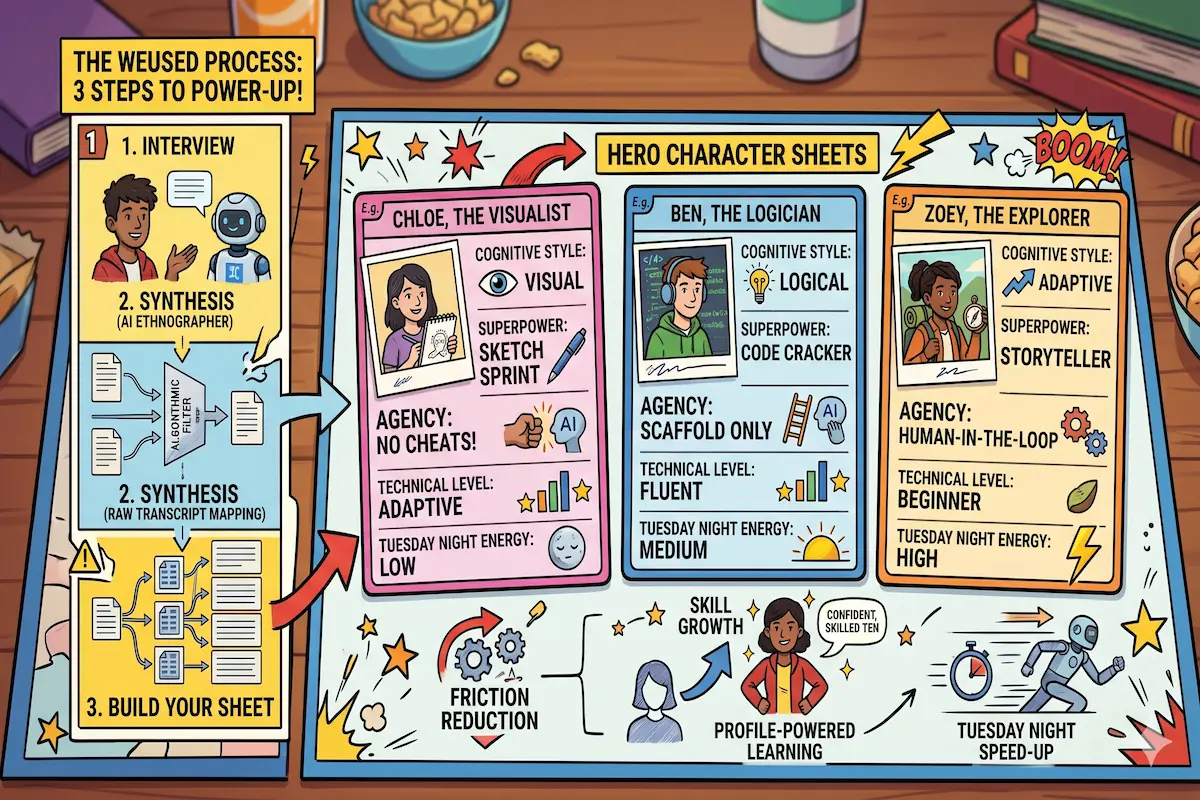
We didn’t just write these profiles ourselves; we used the AI to help us see ourselves more clearly. Here is the high-level workflow we developed:
- The Expert Interview: We turned Gemini into a “Master Ethnographer.” Using a specific set of instructions, Gemini conducted a voice-based interview with each family member. It asked about our interests, our tech-anxieties, and our “Line in the Sand” (what we think is ethical vs. what feels like “cheating”).
- The Synthesis Engine: We took the raw transcript of those conversations and fed them back into a specialized “Synthesis” prompt.
- The Golden Template: The AI mapped our answers into a structured 5-part template covering:
- Core Identity: Our “Bio-Snippet” and goals.
- Cognitive Style: How we process info (Visual? Logical?).
- Agency Guardrails: Our personal rules for human-AI collaboration.
- Technical Footprint: Our current skill level.
- The Tuesday Night Reality: Our actual bandwidth for projects.
The Result
We now have a “Human-AI Partnership Profile” for every member of the family. These aren’t just static documents; they are the “Ground Truth” we will use for every project on this blog. Whether we are coding a game or researching a history project, we start by giving the AI our profile.
The result? The AI stops being a generic bot and starts being a personalized coach.